Cleaning and maintaining a rooflight
A rooflight asks for about an hour a year. Twenty minutes twice, in spring and autumn, plus the glass cleaned as often as you can be bothered. That is the whole routine, and it applies to a manufactured roof window in a Hucclecote loft, a made-to-size flat unit over a Tuffley kitchen, a conservation rooflight in Painswick stone slate and a lantern over a Cheltenham extension alike. What changes between them is how you reach it. This page sets out the general routine across every type: what to clean, what to check, how often, and what a yearly look at the unit is actually looking for. Type-specific methods are on how do you clean the outside of a roof window, how do you clean a roof lantern, how do you clean a rooflight you cannot reach and, for powered units, maintaining an electric rooflight mechanism.
The routine in one paragraph, before the detail
Clean the inside face of the glass whenever it looks dull, which is two or three times a year in most rooms and more in a kitchen. Clean the outside face twice a year, spring and autumn. While you are there, run a finger along the gaskets, look into the drainage channel at the bottom of the frame and clear it, work the sash through its full travel, and look at the covering or the flat roof immediately around the unit. Once a year, from ground level with a pair of binoculars, look at the flashings or the upstand. That is it.
Everything below is why each of those items is on the list and what each one is telling you.
A calendar that suits the Gloucestershire year
| When | What it is for | What gets done |
|---|---|---|
| March or April | Clearing what winter deposited | Both faces of the glass, drainage channel, gaskets, sash travel, moss around the unit |
| June | Before the hottest weeks | Check any shading or blind operates, check the sash and any actuator run freely |
| September or October | Before the leaves come down | Both faces of the glass, gaskets, ventilation filter, gutters and outlets near the unit |
| November | After the leaves have fallen | Clear the drainage channel and any flat roof outlet, look at the head of the unit |
| Once a year, any month | The check that catches things early | Flashings or upstand from ground level, timber finish, fixings, glass condition |
| After a storm | Unplanned, twenty minutes | Look for anything lodged at the head, and for debris on a flat roof |
The November entry is the one people skip and it is the one that matters most in this county. A wet autumn in the vale puts a great deal of leaf litter into places designed to drain, and a channel that silts up in November is a channel that overflows in February.
What actually lands on roof glass here
Roof glass does not get dirty the way a wall window does, and knowing what is on it tells you what will shift it.
Across the county the standard deposit is fine grey road film, tree pollen in May and June, and the tannin stain that runs off overhanging branches. Around the Gloucester ring road and the M5 corridor at Brockworth, Hardwicke and Quedgeley there is more traffic film and it is greasier. In the vale, harvest dust in August is real and it sticks. On the wolds, the deposit is paler and chalkier. In the Forest of Dean and the Stroud valleys, the shade and the damp mean the dominant problem is not dust at all but organic growth: algae as a green bloom on the north edge of a pane, lichen on the frame, and moss on the covering around it that washes silt down onto the glass every time it rains.
Bird droppings are the one deposit worth dealing with promptly rather than at the next scheduled clean, because they are acidic and they will etch a coating if they bake on through a hot week.
Water first, then a mild detergent, in that order
Start with plain water and a soft brush or a microfibre cloth. On a great deal of roof glass that is all it takes, because the deposit is dust rather than grease, and water alone carries no risk to any coating.
Where water is not enough, a few drops of ordinary washing-up liquid in a bucket of warm water is the right strength. Wash, then rinse with clean water, then let it dry or draw a soft squeegee down it. The rinse is the step people leave out, and detergent left to dry on glass is the reason a pane that has just been cleaned looks streaky an hour later.
Work top to bottom so dirty water runs onto glass you have not done yet rather than glass you have. On the outside of a pitched unit that is the natural direction anyway. Choose a dull day or an early morning: bright sun on the glass dries the water before you can rinse it, and every streak sets.
What damages glass and coatings, and belongs nowhere near
Roof glass carries coatings that are worth protecting, and the frames around it carry finishes that are easier to damage than the glass.
- Abrasives. Cream cleaners, scouring pads, wire wool and magic erasers. All of them will scratch a coating and some will scratch glass.
- Solvents. Acetone, cellulose thinners, white spirit and methylated spirit. They attack gaskets and frame finishes even where the glass survives.
- Strong alkalis and acids. Oven cleaner, brick acid, patio cleaner and anything sold to shift cement. A splash of brick acid from work elsewhere on the building will etch glass permanently.
- Pressure washers. They drive water past gaskets, lift laps, and can shift a lead flashing. Never on a rooflight, and not on the covering within a metre of one.
- Blades. A scraper on a coated pane takes the coating off with whatever it was aimed at.
- Silicone sprays on glass. They leave a film that attracts dirt and are very hard to remove.
Where something hard has bonded to the glass, mortar splashes from work above being the usual culprit, soak it with warm water until it softens rather than attacking it dry.
Coated glass: low emissivity inside, solar control and self cleaning outside
Three coatings turn up on rooflight glass and each behaves differently when cleaned.
A low-emissivity coating sits on the cavity face of the inner pane, so it is inside the sealed unit and cannot be touched or damaged. Nothing you do to the inside face of the glass affects it. The coatings on low emissivity coatings and argon fills are protected by the glass they are on.
A solar control coating is usually also inside the cavity on modern units, though some older or specialist products carry a surface coating. If in doubt, treat the outer face as coated and use nothing abrasive.
A self-cleaning coating is definitely on the exposed outer surface, and it is the one that needs a change of habit. It works in two stages: a photocatalytic reaction under daylight breaks down organic dirt, then rain sheets across the surface rather than beading and carries it off. It needs daylight and rain to work, so it performs poorly on a unit shaded by a tree or under a deep overhang, and it takes a few days of exposure to reactivate after installation. Wash it with water and a soft cloth only. Detergent leaves a residue that stops the water sheeting, which defeats the coating until it is rinsed off. It reduces cleaning frequency rather than eliminating it, and it earns its place on any unit that is genuinely hard to reach.
The inside face, and the film that builds on it
The inner pane is the one you look through and it gets dirty from a completely different set of causes. Cooking aerosols in a kitchen, candle soot, cigarette smoke, hairspray in a bathroom, and the general fine film that settles in any room. In a kitchen with a lantern or a flat rooflight over a hob, the grease film builds visibly within months and it dulls the daylight before anyone notices it is happening.
Warm water with a little detergent, then a clean water rinse, then dry with a microfibre. On a kitchen unit a proprietary glass cleaner sprayed onto the cloth rather than onto the glass is fine, because overspray runs into the frame and sits in the drainage channel.
Reach is the practical issue indoors. A centre pivot roof window rotates through 180 degrees and locks on a barrel bolt so both faces come to you. A top hung sash does not rotate, so the inside is done from the room and the outside from outside. Glass over a stairwell or above a kitchen island is a pole and microfibre head job, or a job for whoever cleans your other high windows.
Gaskets and weather seals, and telling one that has gone hard
Every opening unit relies on a compressible seal between sash and frame. It is EPDM or a similar synthetic rubber, it is doing its job when it is soft and slightly springy, and it fails slowly rather than suddenly.
Run a finger round it twice a year. What you are feeling for: a section that has gone hard and no longer springs back, a flat permanent groove where it has been compressed in one place for years, a corner that has shrunk and left a gap, a section that has come out of its retaining groove, and any splitting or crazing. Clean it with water and a cloth while you are there, because grit embedded in a gasket face is what wears it.
The symptoms of a tired gasket arrive before the visual evidence does. A draught you can feel with the unit closed. A whistle in a south-westerly. Daylight visible at the edge of a closed sash. More condensation than the unit used to produce. A silicone-based rubber conditioner applied sparingly once a year keeps a sound gasket supple for years longer, and a gasket that has genuinely gone is a replaceable part on most manufactured units rather than a reason to change the whole thing. Servicing intervals are on do roof windows need servicing.
Drainage channels and weep holes, which is where the water goes
This is the item almost nobody knows about and it is the most useful thing on the page.
A rooflight is not sealed against water. It manages water. Every manufactured roof window has a drainage channel built into the bottom of the frame, with weep holes leading out of it, and its job is to collect the condensation running down the inside of the glass and the small amount of rain that gets past the gasket in a driven storm, and let it out below the flashing. A kerb-mounted rooflight has the same arrangement in the aluminium frame around the glass, draining out onto the membrane. A lantern has channels in the rafters and the eaves beam.
What fills them: dust, pollen, dead insects, tannin from leaves, and in a kitchen a slow accumulation of grease. Once full, the channel stops draining, the water backs up and appears on the reveal below, and a homeowner reasonably concludes the unit is letting water in when the unit is doing exactly what it was designed to do and has simply been blocked.
Clearing it takes two minutes. Open the sash, look along the bottom of the frame for the recess, and run a soft brush or a cotton bud along it. Rinse a cupful of clean water down it and watch it come out of the weep hole. If it does not come out, something is in the hole and a cocktail stick will shift it. Never a wire or anything metal that could damage the surface.
The flat roof around a kerb, and the outlet that serves it
A kerb-mounted rooflight sits in a roof that has to drain, and the unit is only as dry as the roof around it. A kerb turns one roof plane into three catchment areas, and water arrives head-on at a vertical timber face on the upslope side.
So the yearly check extends past the glass. Look for standing water anywhere on the deck, particularly against the upslope face of the kerb, and remember that a pond which is still there forty eight hours after rain is a fall problem rather than a weather one. Clear the outlet and its leaf guard, because a silted spigot turns a designed 1:40 fall into a level pond within a season. Brush the silt out of the corners where the kerb meets the deck. Look at the moss line: moss establishing along the base of a kerb tells you water is sitting there. The physics is on flat rooflight falls, drainage and ponding, and standing water on the glass itself on do flat rooflights hold water after rain.
Walking on a flat roof to do this is fine on most modern warm roof build-ups and is worth checking first, particularly on an older cold roof with a thin deck. Nobody stands on the glass unless it is a walk-on unit specified as such, on walk-on rooflight installation.
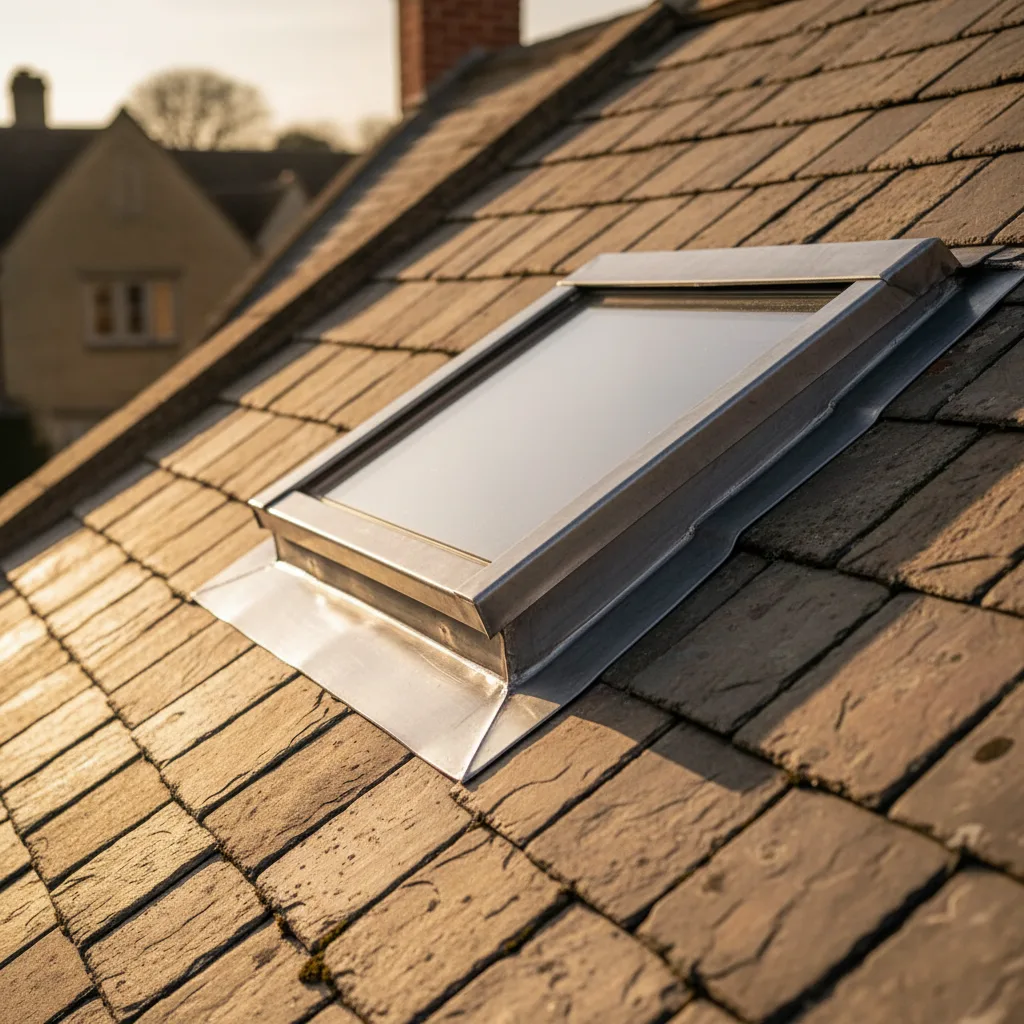
Flashings, laps and lead, looked at from the ground
On a pitched roof the weathering around the unit is a set of flashings, and you can learn a great deal about it from the lawn with a pair of binoculars on a bright morning.
What you are looking for: lead that has lifted or curled at an edge, a crack running along a line of fixings, which is what happens when lead has been nailed down both sides and has torn itself apart expanding, a side flashing that has been pushed out of a tile roll, a slipped or missing slate immediately above the unit, and anything lodged at the head where the flashing tucks under the course above.
None of that needs a ladder to spot and all of it is worth spotting early. The set and how each piece works is on soakers, aprons and head flashings explained.
On a Cotswold stone slate roof the equivalent look is at the courses immediately around a conservation unit, checking that the diminishing gauge is still sitting right and that no slate has slipped at the peg. On a Forest of Dean roof in an exposed position, the head lap above the unit is the place driving rain works on hardest.
Moss, lichen and the shaded slope
Gloucestershire grows moss enthusiastically. North-facing slopes, roofs under trees, the Stroud valleys and the Forest all produce it faster than the vale does, and a roof that is half in shade will have a green side and a clean side.
Around a rooflight, moss matters for three reasons. It holds water against the covering and against the flashing edge. It washes down as silt onto the glass and into the drainage channel. And a thick mat above the unit acts as a small dam, holding water at the head where it has the most opportunity to find a lap.
The sensible response is to brush it off the covering within a metre or so of the unit each autumn, working down the slope rather than up so nothing is driven under a lap. Chemical moss treatments applied to a whole roof are a separate decision with runoff implications, and none of them should be sprayed onto the glass or allowed to sit against lead. Pressure washing a mossy roof is how slates get lifted and flashings get moved.
Timber frames, and the finish they want
Timber roof windows come with a factory lacquer or a factory paint finish, and both have a service life measured in years rather than decades. The inside face is the one that needs attention, because it is the face exposed to the room’s humidity, and in a bathroom or a kitchen it works hardest of all.
Look at the lacquer on the sash near the bottom edge, which is where condensation runs and collects. What you want to see is an unbroken film. What tells you it is time to attend to it is a dulling, a slight roughness to the touch, or dark grey-black spotting in the grain, which is the beginning of the timber taking up moisture.
The interval is commonly three to five years in a bedroom and shorter in a bathroom. The work is light sanding with a fine abrasive and a coat of the manufacturer’s own lacquer or an acrylic equivalent, with the gasket masked off. Doing it before the film breaks is a morning’s work. Leaving it until the timber has darkened is a different proposition. Polyurethane and white-finish frames do not need this at all and want nothing more than washing, which is why they are frequently the better specification for a shower room, compared on timber and polyurethane roof window frames.
Aluminium frames and powder coating
Flat roof rooflights and lanterns are almost always powder-coated aluminium, usually to a polyester powder specification with a long finish warranty. It is a durable finish and it wants very little.
Wash it twice a year with water and a mild detergent, at the same time as the glass, and rinse it. That is genuinely the whole maintenance requirement, and it is also the condition most powder coating warranties are written against, so it is worth actually doing. Pay attention to the horizontal surfaces and any recess where dirt sits rather than washing off, because those are where a coating dulls first.
Do not use solvents on it and do not let brick acid or cement cleaner near it. Where a scratch has gone through to the metal, a touch-in paint matched to the RAL number keeps it sealed. Finishes and colours are on roof lantern frame finishes and powder coating.
Moving parts: hinges, friction stays, catches and rods
Anything that moves wants working through its full travel a couple of times a year, which is often all the attention it needs. A sash that is only ever opened 100mm for ventilation develops a stiff zone in the part of its travel nobody uses.
Hinges and pivot bearings on a manufactured roof window take a drop of light machine oil at the pivot point, wiped off afterwards so it does not run down the frame. Friction stays on a top hung sash have an adjustable friction setting, and a sash that has begun to drop or will not stay where it is put is usually a stay adjustment rather than anything more serious. Catches and locking mechanisms want cleaning and a light lubricant, and a handle that has become stiff is often grit rather than wear.
Operating rods and their hooks want the pole checked for a loose joint and the hook checked for burrs. On electric units the actuator, chain, brackets and controls have their own routine, on what maintenance does an electric rooflight need.
Ventilation flaps and the filter behind them
Manufactured roof windows carry a ventilation flap in the head of the sash with a filter behind it, and it is one of the more useful things on the unit because it gives background ventilation with the window closed and locked.
The filter is a coarse foam or mesh strip that clips out. It loads with dust, pollen and insects, and once loaded the flap stops delivering the airflow it is supposed to. Take it out twice a year, wash it in warm soapy water, let it dry completely and clip it back. In a house near a busy road or in the vale during harvest it loads faster and wants doing three times.
While the flap is open, check it actually closes fully and latches. A flap that has been left open all winter is a draught the occupants blame on the unit, and a flap that never opens is background ventilation the house is not getting. Flaps and filters are on roof window ventilation flaps and filters.
Condensation, and telling it apart from water coming in
Water on the room side of the glass on a cold morning is condensation, and it is the single most common thing homeowners get in touch about. It is not a defect in the unit and it is not water getting in.
The reasoning is simple. Warm air holds moisture, a house generates a great deal of it from cooking, showers and drying clothes indoors, that air rises, and the coldest surface in a room is the overhead glass. So the glass is where the moisture lands first, and on a clear cold morning a rooflight can run with water while every other surface in the room is dry.
What tells you it is condensation: it appears on cold clear mornings rather than during rain, it is on the room face of the glass where you can wipe it, and it has gone by midday. What tells you something else is happening: it appears during and after rain, it runs down the frame rather than the glass, or it shows as a mark in the plaster at the top corners of the reveal, which is a cold bridge rather than a water path. Cloudiness between the panes that never wipes off is a failed sealed unit, on misted sealed units and why they go.
Managing it is ventilation and reveal geometry rather than anything to do with cleaning, and it is set out on condensation, ventilation and rooflights. Telling the three cases apart is on telling a failed unit from a failed installation.
Working safely, and the glass nobody stands on
Most of this routine happens from inside the room or from a flat roof, and that is deliberate.
Nobody stands on rooflight glass. A standard sealed unit is not a working platform and it will not tell you it is about to give way. Walk-on units are a specific product with a specific build-up and they are the only ones designed for foot traffic. Nobody works off a ladder leaned against a gutter to clean a roof window either, because the gutter is not designed for it and the ladder foot on a wet lawn is the problem rather than the height.
The realistic options for glass out of reach are a water-fed pole and brush from ground level, a mobile tower on firm level ground, or a professional window cleaner equipped for it. Where a unit is genuinely unreachable, that is a specification decision made at order stage rather than a problem to be solved afterwards: a self-cleaning outer coating and, if it opens, an electric actuator with a rain sensor. The whole question is on how do you clean a rooflight you cannot reach.
What a yearly look catches before it becomes a job
The point of the routine is that almost everything on a rooflight gives notice.
A gasket goes hard for two winters before it lets a draught through. A drainage channel silts up gradually and the reveal only gets wet once it is full. Lacquer dulls before the timber darkens. Moss builds for three seasons before it dams the head of a unit. An outlet silts before it ponds. A friction stay loosens before the sash drops. Every one of those is twenty minutes of attention at the right moment and a considerably larger piece of work if it is left.
Two things do not give notice and are worth knowing about. A sealed unit’s edge seal fails when it fails, and the first sign is cloudiness between the panes. And a storm can lift a flashing edge in one night. Neither is preventable by cleaning, which is why the yearly look includes a glance at the perimeter from the ground.
When a unit has reached the end of its service life
Rooflights wear out, and a unit at the end of its service life is a replacement rather than a maintenance item. Fifteen to twenty-five years is a normal life for a sealed unit in a roof, shorter than a vertical window because the glass takes direct sun for hours, lies nearly horizontal so the edge seal spends more of its life wet, and gets more ultraviolet exposure than any other glazing on the building. Expected life is on how long does a roof window last.
The signals, taken together rather than singly: cloudiness between the panes that no amount of cleaning shifts; gaskets hard and shrunken all round rather than in one place; a sash that has dropped out of square and will not latch without lifting; timber that has darkened through the lacquer; and a frame profile so old that spare parts are no longer made for it.
At that point a new unit into the existing opening is usually the better outcome than continuing to service an old one, and it is the moment when a glass upgrade costs almost nothing extra in labour because the frame is coming out anyway. That work is on replacing a failed or misted rooflight.
Severn fits new rooflights and replaces units that have reached the end of their life, and the workmanship carries a ten-year guarantee written against the perimeter details. If something on the yearly check looks wrong and you are not sure what you are looking at, a photograph of the glass and one of the roof around it, sent to info@severnskylightsgloucester.co.uk, will usually get a straight answer within a day or two. The full technical picture of how these units are built into a roof sits on the skylight and rooflight installation hub.
Next on this subject.
- Guide What a rooflight costs in Gloucester Two rooflights of exactly the same size and specification, one going into a Quedgeley semi with a driveway and concrete…
- Guide Sizing a rooflight for the room Size a rooflight from the room, not from the roof. The roof sets the limits and it will tell you…
- Guide Roof window or rooflight, and the difference Once the vocabulary is straight, a real decision is left behind it: for a given room on a given roof,…
- Guide Flat roof against pitched roof rooflights Most people arrive at this question having already chosen a product and then discovered the roof has opinions. It is…
- Guide What happens on installation day A rooflight installation is one of the few pieces of building work that opens the outside of your house and…
- Guide Rooflight planning permission and building regulations Two separate sets of rules apply to putting a rooflight in a roof. They are written by different legislation, administered…