Roof lantern ridge vents and how they are operated
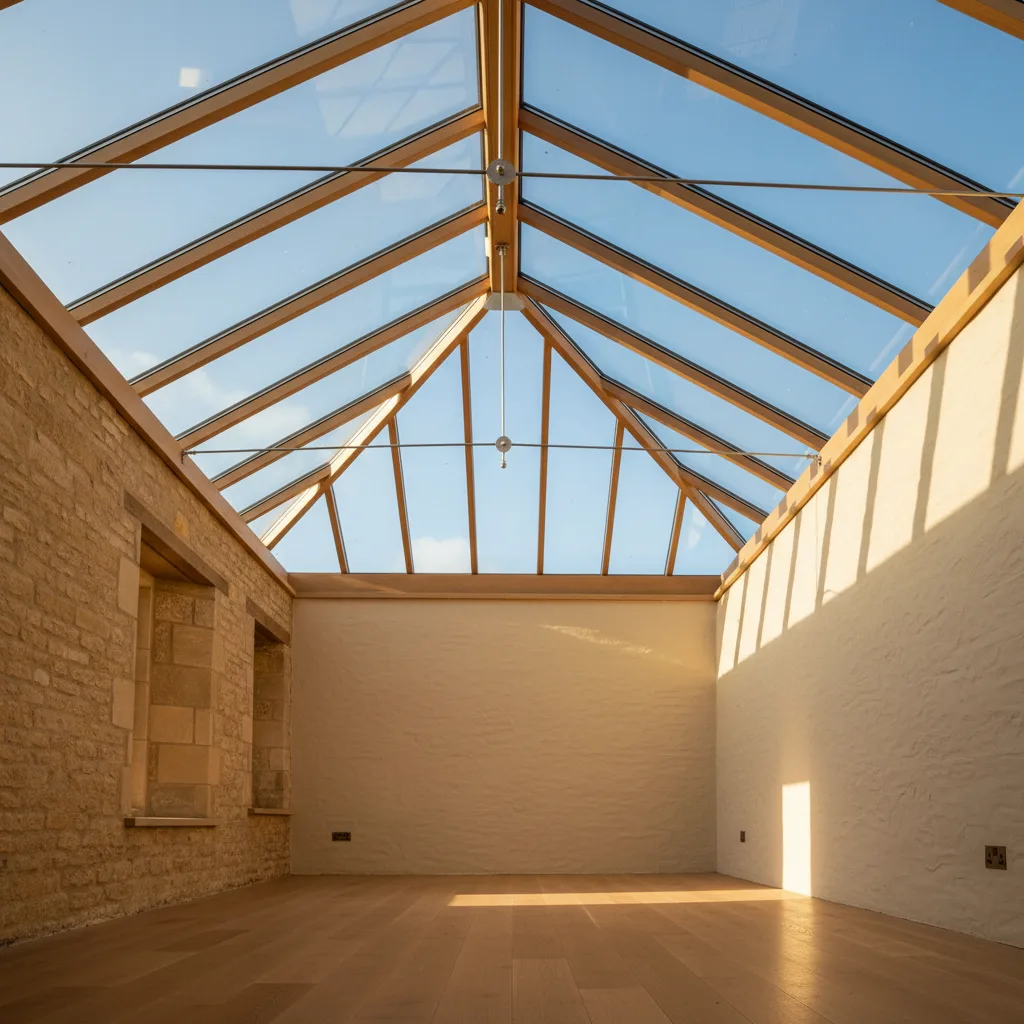
Hot air collects at the top of a lantern, which is why the vent goes there and not in the flat roof beside it. What that vent actually is varies more than people expect: a whole pane on hinges, a smaller sash set into one slope, or a louvred unit in the ridge extrusion itself, each driven by a different mechanism with a different stroke and a different free area. The general case for venting a lantern is on the roof lantern installation page. This page is the mechanics: how much air a given vent actually moves, what drives it, what the switch and the sensors do, how the opening pane stays dry, and what has to be decided before the ceiling is boarded.
Three ways a lantern opens, and only one of them is a ridge vent
The words get used loosely, so it is worth separating them.
An opening pane replaces one of the sloping panes with a hinged sash, hinged at its top edge under the ridge and pushed out at the bottom. It gives the largest opening of the three, the sash is the same size as the pane it replaces, and it is what most people mean when they ask for an opening lantern.
A ridge vent proper is a narrower unit running along the ridge itself, lifting on a parallel arm mechanism so that air escapes along both sides of the top. It gives a smaller free area than a full pane but it sits at the highest point of the volume, which is exactly where the warmest air is, and it barely changes the appearance of the lantern when shut.
A louvred ridge unit uses a set of glass or aluminium blades in the ridge that rotate open. It offers a good free area for its size, it can be left partly open in light rain, and it has more moving parts and more gasket length than either of the others.
Where the hot air actually sits inside a lantern
Air stratifies. In a room with a glazed roof on a hot afternoon, the temperature at the ridge can be five to eight degrees above the temperature at head height, because warm air rises and has nowhere to go. That layer sits trapped inside the pyramid of the lantern doing nothing except radiating back down.
An opening at the top of that volume lets it leave. An opening at the bottom, in the flat roof or in a window, does not, because the buoyant air is already above it. The physics is the whole argument for putting the vent at high level rather than choosing the position for convenience, and it is why a vent in the lantern outperforms a much larger openable window in the same room for removing heat.
It also explains a complaint that comes up in winter. A vent at the ridge left cracked open in January drains the room of the warmest air in it, faster than any other opening in the house, so the trickle setting on a lantern vent is not a background ventilator and should not be treated as one.
Free area, and the figure that decides whether a vent does anything
Two numbers describe how much air an opening passes and they are not the same.
Geometric free area is the physical size of the gap, measured as the clear opening the air can pass through. On a top hung sash pushed out at the bottom, that gap is not the pane area: it is the area of the opening at the bottom edge plus the two triangles at the sides, which is a fraction of the pane until the sash is well open.
Aerodynamic free area is the geometric area multiplied by a discharge coefficient that accounts for the losses as air turns through the gap, typically around 0.6 to 0.65 on a hinged sash. It is the honest figure and it is the one used in ventilation calculations.
Some arithmetic on a real vent. A 700 by 1000mm sash on a 25 degree slope, opened to 300mm at the bottom edge, gives a bottom gap of about 0.21 square metres plus two side triangles of about 0.10 square metres each, so roughly 0.41 square metres geometric and about 0.26 aerodynamic. Purge ventilation to a habitable room asks for an openable area of at least a twentieth of the floor area, so that vent alone covers about a 5 square metre room on the geometric figure. It is a useful contribution to a 24 square metre kitchen, not a substitute for the doors.
Stack effect across the height of a lantern
A vent at the top only works properly if air can get in somewhere lower down. The driving force is stack pressure, which depends on the temperature difference and on the vertical distance between the low inlet and the high outlet.
On a single storey extension the height difference between a door head at 2.1 metres and a lantern ridge at 3.1 metres is only about a metre, so the stack pressure is small and the flow modest. Open the doors and the vent together and it works, but the wind does more of the work than the temperature does. Over a stair void or a double height space, where the ridge might be 5 or 6 metres above an open door on the ground floor, the stack effect becomes powerful and a relatively small vent moves a surprising volume of air. That is the situation where a lantern vent genuinely ventilates a house rather than a room.
The practical rule: pair the high vent with a low opening, and make the low opening at least as large. A vent on its own in a sealed room does very little except let air shuffle in and out of the same gap.
Chain actuators, and the stroke that sets the opening angle
The commonest driver on a lantern pane is a chain actuator: a small motorised unit with a rigid link chain that pushes out of a housing in a straight line and folds back into it. The housing is compact enough to hide inside a rafter or a ridge extrusion.
The number that matters is stroke, the length the chain extends, commonly 200, 300 or 400mm. Stroke, not motor power, sets how far the sash opens, and stroke times the geometry of the hinge sets the free area. A 200mm stroke on a 1000mm long sash gives an opening angle around 11 degrees. A 400mm stroke on the same sash gives about 23 degrees and nearly doubles the free area.
Chain actuators are quiet, they run at low voltage, they take about 30 to 60 seconds through their full stroke, and they hold position anywhere along it so a partial opening is available. Their limit is thrust: a chain will push a domestic sash comfortably and it will not push a very large heavy pane against a wind load, which is where the other mechanisms come in.
Linear rams and scissor arms on a sloping pane
Where the sash is large, heavy or exposed, the driver becomes a linear ram: a telescopic spindle actuator with a much higher thrust and a shorter, stiffer travel. Rams are used in pairs on wider sashes so the load is shared and the sash cannot rack, and they hold a sash against wind pressure far better than a chain will.
Scissor arm or folding arm mechanisms take a different approach, lifting the sash on a linkage that keeps it parallel to the frame rather than tilting it. A parallel lift gives ventilation all the way round the sash instead of just at the bottom edge, so the free area for a given movement is much better, and it is the mechanism behind most ridge vents and louvred units.
Both cost more than a chain and both take up more room in the frame, which is why they have to be decided before fabrication. A lantern is built around the mechanism it is going to carry, and the rafter or the ridge is machined for it in the workshop.
24 volt against 230 volt, and where the transformer lives
Most lantern actuators are 24 volt direct current, which is a safety and a control decision. Extra low voltage cable can be run without special protection, the motor reverses simply by swapping polarity, and the same wiring can carry position feedback.
That means there is a power supply unit somewhere converting 230 volt mains to 24 volt, and it has to live where it can be reached: in a cupboard, a service void or an accessible ceiling position, not buried above plasterboard with no hatch. It gets warm, it needs a little air around it, and it is the component most likely to need attention in fifteen years. Cable runs from it to each actuator, sized for the length so the voltage does not sag over a long run.
A few larger or older units are 230 volt at the motor. They need fewer components and the mains cable has to be run and terminated to the standard the electrical regulations require, with the certificate that goes with it. Either way, any mains side work is certified as part of the job, and the general wiring practice is set out on the wiring an electric rooflight at first fix page.
The drained and vented rebate on an opening pane
A fixed lantern pane is bedded and sealed, so nothing has to get past it. An opening pane cannot be sealed shut, and that changes the whole detail around it.
The sash sits into a rebate with a compression gasket on the frame and a second wiper or bubble gasket on the sash. Between the two, the rebate is drained and vented: a chamber that collects any water that gets past the outer gasket and takes it out through slots at the low edge, with vent slots that equalise the pressure across the outer seal so wind cannot drive water uphill through the gap. That pressure equalisation is what actually keeps the pane dry, more than the gasket does.
Two things follow. The drainage slots have to stay clear, so a lantern with an opening pane wants the sash gasket line looked at when the glass is cleaned, and the leaf litter that collects at the bottom of a sash in a garden with trees around it will block the slots within a couple of autumns. And the sash has to close onto the gasket evenly all round, which is why the frame is checked for square and level before glass goes in and why a kerb that dips in the middle causes trouble on an opening lantern that a fixed one would tolerate.
Weather sensors that override the switch
A rain sensor is a small conductive plate, usually heated so it dries out quickly, mounted where rain will actually reach it. When water bridges the plate the controller closes the vent regardless of what the switch says, and it stays closed until the plate is dry.
Position decides whether it is useful or infuriating. A sensor tucked under the ridge cover on the sheltered side of a lantern gets wet late and dries slowly. One on an exposed corner gets wet early, which is what you want, and also reacts to a passing hose or a heavy dew. Sensors have a sensitivity adjustment and it is worth setting it after living with the lantern for a month rather than on the day.
Wind sensors matter more on a lantern than on a roof window, because an open sash on a slope is a sail. An anemometer input closes the vent above a set wind speed, and on an exposed site, a Cotswold edge plot at Birdlip or above Cleeve, or a Forest of Dean hillside taking south westerlies with nothing in front of them, it protects the actuator and the hinges from a load they were never sized for. Obstruction detection in the controller stops the motor if the sash meets resistance on the way down, which is the safeguard that matters if somebody has left a pole on the glass.
Thermostats, humidity sensors and the vent that opens itself
Automatic control turns a vent from something people forget into something that works. Three inputs come up.
A thermostat at ceiling level opens the vent above a set temperature and closes it below, which is the single most useful automation on a lantern over a kitchen. A humidistat opens it above a set relative humidity, which suits a room where moisture rather than heat is the problem, and it will run the vent after a shower or a long simmer without anyone deciding to. A timer or scheduler gives a purge at a set hour, which is how a lantern gets used to flush a house on a summer morning before the day heats up.
All three are overridden by the rain and wind inputs, in that order of priority: weather beats automation, automation beats the wall switch, and the wall switch beats nothing. Understanding that hierarchy saves a call about a vent that will not open in a downpour.
Manual operation: winders, rods and spring assist
Not every vent needs a motor. A manual winder works a worm gear through a flexible drive, cranked by a removable handle at the end of a rod, and it will drive a sash open steadily and hold it at any point. A pole operated catch and stay suits a sash within reach of a two metre pole, which on a single storey extension with a 2.4 metre ceiling means a lantern above head height is workable and a lantern over a stair is not.
Gas struts and spring assist reduce the effort by carrying part of the sash weight, and they are what makes a heavy glazed sash liftable by hand at all. They also lose pressure over ten or fifteen years and get replaced.
The decision is about reach, and there is a practical line at about 2.3 metres from the floor to the operating point. Above that, a manual vent becomes a vent nobody opens, and a vent nobody opens is worse than a fixed pane because it has gaskets and drainage slots to look after and no benefit. Electric operation on units out of reach is covered on the electric rooflights out of reach page.
The decision that has to be made before the ceiling closes
An opening vent is not a fitting added at the end. It changes the frame, so it is settled at survey.
What it changes: the rafter or the ridge is machined in the workshop to house the actuator; the pane that opens is fabricated as a sash with its own frame and gasket set, so the pane layout may shift to put the sash where it is wanted; the low voltage cable has to be run to the actuator position and to the sensor position before the kerb lining is boarded; the power supply needs an accessible home; the switch position has to be chosen and a cable run to it; and the vapour control layer has to be sealed around every cable penetration rather than pierced and left.
Retrofitting is possible and it is not equivalent. Adding an actuator to an existing lantern means removing a pane, fitting a sash of the same size if the system offers one, and running cable through a finished ceiling, and on many systems the pane cannot be converted at all because the rafter was never machined for it. That is the argument for deciding at survey even where the vent will not be used often.
Vent types against what each one delivers
| Vent type | Usual driver | Free area for its size | Rain tolerance when open | Where it earns its place |
|---|---|---|---|---|
| Full pane, top hung under the ridge | Chain actuator, 300 or 400mm stroke | Largest of the three, but only when well open | Poor. Rain enters the opening directly | The default on a domestic lantern over a kitchen or dining space |
| Smaller sash set into one slope | Chain actuator, 200 or 300mm stroke | Moderate | Poor to moderate | Where the pane layout is fixed and only one bay can be a sash |
| Ridge vent on parallel arms | Linear ram or folding arm | Good for its size, air leaves both sides | Moderate. The ridge cover shelters the gap | Highest point of the volume, and almost invisible when shut |
| Louvred ridge unit | Rotating blade mechanism | Good, adjustable in stages | Best. Blades can sit part open in light rain | Where venting is wanted often and in changeable weather |
| Manual winder on a sloping sash | Worm gear and rod | As the sash allows | Poor | Within reach, on a lantern where power is awkward |
| Separate opening rooflight in the flat roof | Chain or spindle actuator | Independent of the lantern | Poor to moderate | Cross ventilation across a wide extension, low in at one end and high out at the other |
Cooking moisture, and the vent that is not an extractor
A vent over a kitchen is often bought to deal with steam, and it does help, but it is not an extract system and it does not replace one.
An extract hood over a hob captures moisture and grease at source, at the point where the plume is concentrated, and ducts it outside at a known flow rate. A lantern vent removes the warm humid air that has already spread across the ceiling. Both are worth having and they do different jobs. The regulations treat them differently too: mechanical extract to a kitchen has a required rate, and purge ventilation through openable areas is a separate requirement counted across the whole room, which changes when a kitchen is extended and roofed in glass.
What a lantern vent does very well is clear the moisture that condenses on the glass on a cold morning. Ten minutes of purge after breakfast moves more water out of a kitchen than any amount of wiping. The condensation mechanism itself is covered on the roof lantern condensation in a kitchen page.
Insect screens, security and a sash three metres up
An open pane in a roof invites two things in. Insects arrive because a lit opening at night is a beacon, and Gloucester’s proximity to the river means midges and flies in numbers on a still July evening. An insect screen for a lantern sash is a fine mesh in a frame or a roller cassette on the inside of the sash, and it has to be specified with the sash because it needs a fixing rebate. Mesh costs a little free area, typically 20 to 30 per cent of it, which is worth allowing for in the arithmetic.
Security is more often an anxiety than a real exposure, because a lantern sash three metres above a garden with no wall or drainpipe within reach of it is a poor route into a house. Where the extension is single storey and a flat roof can be climbed onto from a boundary wall, which happens on Gloucester and Cheltenham terraces with rear alleys, it is worth taking seriously. The answers are a laminated inner pane, which is already standard overhead, multi point locking on the sash rather than a single catch, and an actuator that holds position under load rather than a friction stay. A closed actuated sash cannot be pushed open, because the chain or the ram is a mechanical link.
Smoke ventilation is a separate product with its own certification and it is not what a comfort vent provides, which is covered elsewhere under electric rooflight installation.
What actually needs attention, and how often
A lantern vent has four wearing parts and they fail in a predictable order.
The gaskets harden and take a set, and after a decade or so a sash that has been left open through summers stops compressing evenly. They are replaceable lengths pushed into a groove. The drainage slots in the rebate collect debris, and clearing them once a year with the glass cleaning is the single most useful thing an owner does. The rain sensor plate collects a film of dust and grime that holds moisture and makes it slow to reset, so a wipe each spring keeps it honest. And the actuator itself, chain or ram, has a duty cycle rated in thousands of operations and will typically outlast the glass on a domestic vent, with the power supply more likely to go first than the motor.
None of that needs scaffold if the sash can be reached from a window or a tower. Where it cannot, the annual check goes on the list with the glass cleaning and is done with the same access. What each mechanism needs is set out further on the maintaining an electric rooflight mechanism page.
Gloucestershire nights, and the vent that earns its keep
Two local patterns make a high level vent more useful here than the physics alone suggests.
The Severn Vale holds warm humid air on a still summer night. Gloucester, Tewkesbury and the low villages along the river sit in it, and a house that has taken sun all afternoon does not shed heat easily after dark because the outside air is barely cooler and hardly moving. A thermostatically controlled ridge vent left to run overnight uses what temperature difference there is, all night, without anyone thinking about it, and by six in the morning the room is genuinely cooler. That is worth more in the vale than in a hilltop village where the night air drops sharply anyway.
The second is the wind. On the Cotswold edge above Birdlip, Crickley and Cleeve, and on the Forest of Dean slopes above Coleford and Cinderford, there is nearly always air moving, and a vent on the sheltered side of a ridge in a breeze pulls air out of a room by suction rather than by buoyancy. On those sites a wind sensor is worth having for the same reason: what makes the vent effective is also what will load the sash on a bad day. Whether a lantern can be opened at all is answered briefly on can a roof lantern be opened, and where Severn works is listed on the areas pages.
Next on this subject.
- Guide Sizing a roof lantern for the room below The right size for a roof lantern is worked out from the room, not from the roof. The roof sets…
- Guide Aluminium and timber roof lanterns compared Aluminium and timber are not two finishes on the same product. They are two different structural materials with different stiffness,…
- Guide Roof lantern glazing and solar control Glass in a lantern faces almost straight up at the sky, which is the hardest position glass gets asked to…
- Guide Structural openings and steel for a roof lantern A lantern puts real weight onto the perimeter of a hole cut in a roof, and that combination is what…
- Guide Roof lantern pitch and how steep it should be Pitch is the one lantern dimension that is chosen almost entirely for looks and then quietly governs half a dozen…
- Guide Roof lantern kerbs and who builds them The kerb is built by whoever is building the flat roof, and on a great many jobs that is not…