Acoustic glazing and rain noise
Rain on a rooflight is not the same problem as traffic through a rooflight, and specifying for one does very little for the other. Traffic, aircraft and voices are airborne noise arriving at the glass through the air. Rain is impact noise, generated at the outer surface by drops hitting it and radiated directly into the room by the pane itself, which behaves like a drum skin. The two are reduced by different properties of the glazing, they are measured by different laboratory methods, and a unit optimised for road noise can still drum in a downpour. This page separates them and sets out what actually quietens each. The wider glazing picture is on the energy efficient rooflights hub.
Impact noise and airborne noise are two separate mechanisms
When a car passes, sound waves travel through the air, strike the outer pane, set it vibrating, cross the cavity, set the inner pane vibrating, and re-radiate into the room. Everything in the build-up that resists that chain helps: mass, an air or gas gap, damping, and dissimilar panes that do not vibrate happily together.
When a raindrop lands, none of that applies. The energy is delivered as a mechanical impulse straight into the outer pane. That pane is already the inside of the system as far as the impulse is concerned, and a cavity behind it does comparatively little, because the vibration is being transmitted through the glass and the frame rather than through the air. This is why a triple glazed unit can be excellent on road noise and only modestly better than double on rain.
The numbers on a specification sheet, and what each one covers
Three figures turn up and they are not interchangeable.
- Rw is the weighted sound reduction index for airborne noise, in decibels, from a laboratory test. Higher is better. A typical domestic double glazed unit sits around 29 to 33 dB.
- Rw + Ctr adds a correction for low frequency traffic noise, and it is always the more honest number for a house near a road. The correction is usually between minus 3 and minus 6 dB, so a 34 Rw unit may be 29 in traffic terms.
- Rain noise level is a different measurement entirely, expressed as a sound intensity level in dB(A) generated inside the room under a standardised artificial rainfall applied to the outside of the element. There is a laboratory method for it, and manufacturers who take rain noise seriously publish a figure. Lower is better.
A specification that quotes only Rw tells you nothing useful about a wet night in the Forest of Dean.
Mass and damping: the two properties that quieten a drum
Making a pane heavier reduces how much it moves for a given impulse. Doubling the mass of a single sheet of glass is worth in the order of 4 to 5 dB across most of the range, which is the practical form of the mass law. Going from a 4mm outer to a 6mm outer is a real and audible change.
Damping does something different and, for rain, more valuable. A damped pane converts vibration into heat inside the material instead of radiating it as sound, so the ringing stops almost immediately rather than sustaining. Monolithic toughened glass has almost no internal damping. Laminated glass, which is two sheets bonded by a plastic interlayer that shears slightly under vibration, has a great deal. That is the mechanism behind almost every worthwhile improvement in rain noise.
Laminated outer panes, and the interlayer that does the work
A standard laminated pane uses a polyvinyl butyral interlayer, commonly 0.38mm or 0.76mm thick, and it is already noticeably quieter than an equivalent thickness of monolithic glass. An acoustic interlayer is a modified, softer PVB designed specifically to shear more under vibration, and it improves airborne performance by a few decibels and rain performance by more.
The important and slightly counter-intuitive point for a rooflight is that the laminate belongs on the outer pane if rain noise is the target, because that is the pane taking the impact. Safety requirements often put laminated glass on the inner pane, over habitable space, a stairwell or a bath, and that inner laminate does little for the drumming. A unit that is toughened outside and laminated inside is safe and still noisy in a downpour. Laminated on both faces is the answer where both jobs need doing.
Asymmetric panes, and the resonance you get for free by avoiding it
Two panes of the same thickness with a cavity between them form a mass-spring-mass system with a resonant frequency, and at that frequency the unit performs distinctly worse than either pane would alone. Both panes also share the same coincidence dip, a frequency at which the bending wavelength in the glass matches the wavelength in air and the glass becomes almost transparent to sound.
Making the two panes different thicknesses moves the two coincidence dips apart so that neither pane is weak at the same frequency as the other. A 4mm/16mm/4mm unit is the worst common case. A 6mm/16mm/4mm unit costs very little more and typically gains 2 to 3 dB. Replace the 6mm with a 6.8mm laminate and the gain is larger again, without changing the frame, the sightline or the U-value in any meaningful way.
Cavity width, gas fill, and where they stop helping
A wider cavity lowers the mass-spring-mass resonance and improves airborne reduction, but the improvement flattens off. Beyond about 16 to 20mm, the thermal performance of an argon-filled cavity starts to fall away as convection sets in, so the cavity width in a domestic sealed unit is fixed by heat, not by sound. Acoustic units for a genuinely noisy site sometimes use a wider cavity with a different gas or a secondary glazing arrangement, which is a different product.
Argon and krypton fills are specified for their thermal conductivity, not their acoustic properties, and their effect on sound is small. The details are on low emissivity coatings and argon fills. The realistic conclusion for a rooflight is that the cavity is set by the thermal specification and the acoustic work is done at the panes.
Where triple glazing lands on this question
Triple glazing adds a third pane and a second cavity, and for airborne noise it can help, particularly if the three panes are different thicknesses. Where it disappoints is when all three panes are thin and equal, because the extra mass-spring-mass system introduces a second resonance and the unit can perform no better than a well specified double.
For rain specifically, the outer pane is what matters, and a triple unit with a 4mm toughened outer will drum in the same way a double with a 4mm toughened outer does. Whether the third pane earns its place at all is set out on triple glazing in a rooflight and when it pays.
Polycarbonate domes and GRP: the loudest thing on any roof
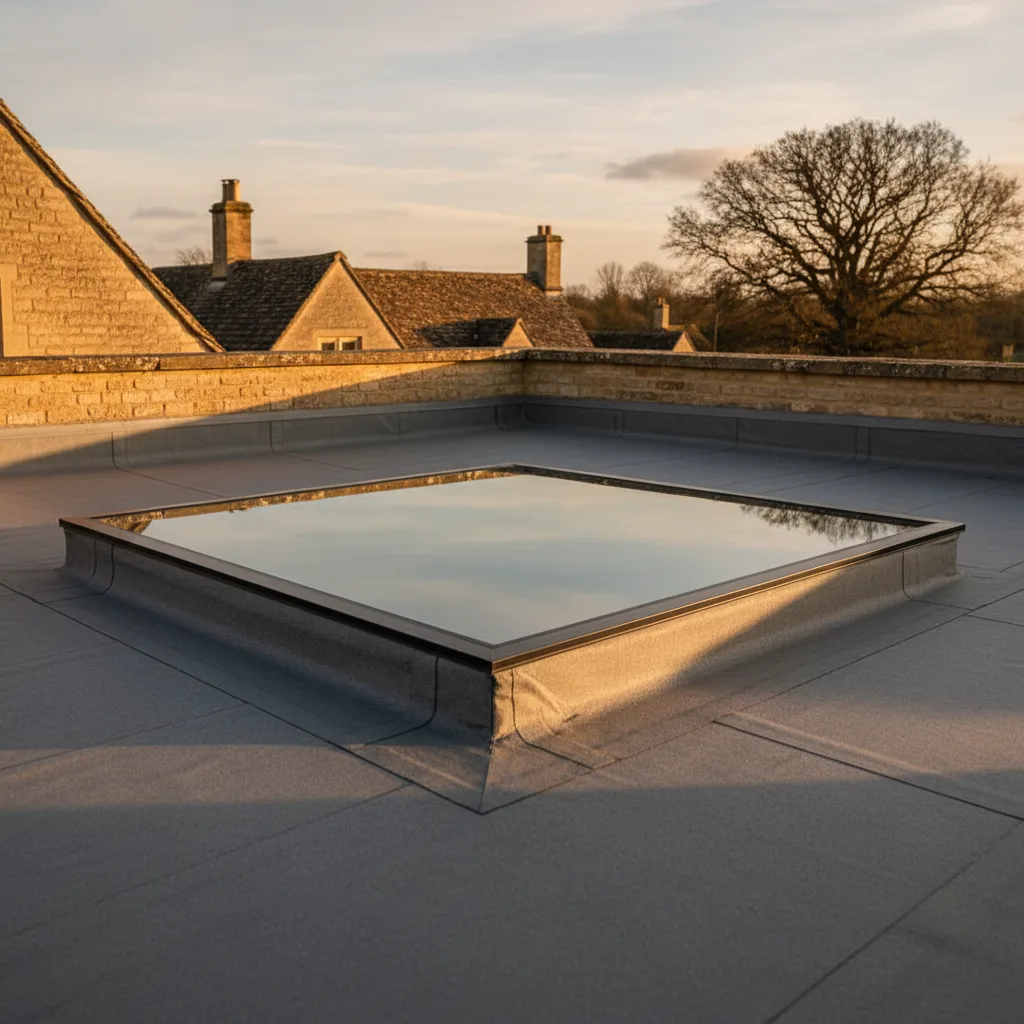
The old plastic dome on a 1980s flat roof extension is the noisiest rooflight ever fitted. Polycarbonate and acrylic are light, thin and springy, which is a precise description of a loudspeaker cone. Multiwall polycarbonate is worse still, because the internal webs give it a set of resonances of its own and the sheet rings for a moment after each drop.
Anyone replacing a dome with a glass unit reports the same thing: the loss of noise is more noticeable than the gain in daylight. A 6.8mm laminated outer pane against a 3mm acrylic dome is not a marginal improvement, it is a different room in heavy rain. That job is on the replacing a failed or misted rooflight page.
The angle of the glass, and how much energy a drop actually delivers
A drop falling onto glass set at five degrees delivers almost all of its momentum perpendicular to the surface. On a 45 degree Cotswold slope, a large part of that momentum is redirected along the glass instead of into it, and the drop then runs off. The same rainfall is quieter on a steep roof window than on a shallow flat roof unit, and this is one of the few acoustic variables already decided by the building.
It follows that shallow units, made-to-size rooflights on flat rear extensions and the low upper slopes of Cheltenham mansards, are where the glass specification has to do the most work. A lantern is an intermediate case, with its panes typically at 25 to 35 degrees.
The frame, the kerb and the noise that travels through structure
Vibration in the outer pane passes into the frame, from the frame into the kerb, and from the kerb into the deck and the ceiling below, which then radiates it into the room. This structure-borne path is why a unit can still be audible when the glass itself has been improved.
Breaking that path is ordinary good practice rather than an acoustic upgrade. The frame beds on a compressible tape rather than sitting hard down on timber. The kerb is insulated through its depth, which adds mass and damping at the same time. The plasterboard reveal is fixed to a lining rather than tight against the frame, and a second layer of board on a reveal is a cheap and effective addition while it is being built. The same insulated kerb detail that fixes the heat loss described on thermal bridging at the rooflight perimeter quietens the junction as a side effect.
Loose flashings, fixings and the rattle that is not the glass
Not every noise from a rooflight comes from the glazing. Lead face-nailed down both sides and now cracked along the nail line lifts and drops in gusts. A trim clipped rather than fixed can buzz at a particular wind speed. A dry-fixed dry verge or a loose tile at the head of the opening ticks.
These are worth eliminating before spending money on acoustic glass, because they are usually the sound people describe as the rooflight being noisy. A survey that includes a look at the flashings on a windy day settles it quickly, and the fix is a detailing question rather than a glazing one.
Typical build-ups and what they achieve
Figures below are industry-typical ranges for domestic units rather than any manufacturer’s published data, and the rain column is a relative ranking rather than a laboratory value.
| Build-up | Typical Rw | Rain noise, relative | Where it fits |
|---|---|---|---|
| 3mm acrylic or polycarbonate dome | 18 to 22 dB | Very loud, sustained ringing | Existing 1970s and 1980s flat roofs |
| Multiwall polycarbonate sheet | 20 to 24 dB | Loud, with a hollow resonance | Outbuildings and older conservatory roofs |
| 4mm toughened / 16mm argon / 4mm toughened | 29 to 31 dB | Noticeable drumming | The base double glazed specification |
| 6mm toughened / 16mm argon / 4mm low-e | 31 to 33 dB | Reduced, still audible | A worthwhile default upgrade |
| 6.8mm laminated outer / 16mm argon / 4mm low-e | 33 to 35 dB | Substantially quieter | Flat roof units and shallow lanterns |
| 8.8mm acoustic laminated outer / 20mm / 6.8mm laminated inner | 37 to 40 dB | Quietest realistic domestic build-up | Roads, flight paths and exposed valley sites |
| Triple, 4 / 12 / 4 / 12 / 4 all toughened | 30 to 33 dB | No better than the equivalent double | Specified for heat, not for sound |
Three different noises around Gloucester, and three different answers
Road noise along the A40, the A38 and the M5 corridor through Quedgeley, Brockworth and Hardwicke is low frequency and continuous, so the figure to look at is Rw + Ctr and the lever is mass and asymmetry. Aircraft from Gloucestershire Airport at Staverton, over Churchdown and the north of the city, is broadband and intermittent, and responds well to a laminated inner pane as well as an outer. Rain is impact, and responds to the laminated outer and to damping at the frame.
Where a house has all three, the specification is an acoustic laminated outer, a laminated inner for safety and airborne performance, dissimilar thicknesses, and a properly bedded frame. That combination costs more than a standard unit and less than most people expect, and it is only sensibly ordered at the time the unit is made.
Forest of Dean and Stroud valley conversions, where rain decides the specification
The Forest is measurably wetter than the vale, and driving rain arrives from the south west with real force behind it. Coleford, Cinderford, Mitcheldean and Lydney sit under it, and a loft conversion in a former mining terrace puts a bedroom ceiling directly under Welsh slate and a roof window. A shallow-pitched unit in that position, glazed with two thin toughened panes, will wake people up.
The Stroud valleys have their own version of the problem. Chalford, Rodborough, Nailsworth and the hillside terraces above the town channel weather along the valley, and the rooms most often converted are those with no wall left to put a window in, so the glazing is overhead by necessity rather than by choice. In both places the laminated outer pane is the single most useful thing on the order, and because scaffold access is difficult and expensive, it is specified at the outset rather than revisited.
Specifying for quiet without giving up the other numbers
The reason acoustic specification is easy to get wrong is that it competes for the same three or four slots in a sealed unit as the thermal and solar requirements. There is one outer pane, one cavity and one inner pane, and every property wants a say in them.
In practice they coexist better than expected. The low-emissivity coating sits on the inner pane and is unaffected by laminating the outer. A solar control coating sits on the outer surface of the outer pane and works just as well on a laminate. The argon fill is unchanged. What does change is weight, and a thicker laminated outer adds a few kilograms per square metre, which matters for the trimmer design, for a large lantern, and for lifting glass into a Stroud valley garden by hand. That is a survey question rather than an obstacle, and it is one of the things recorded before the order goes in. The rest of the glazing decision is on U-values and glazing specification, and the way orientation feeds into the same order is on specifying glazing by which way the slope faces.
Next on this subject.
- Guide U-values and glazing specification A U-value is the rate at which heat crosses one square metre of a finished rooflight for every degree of…
- Guide Solar gain, overheating and shading Overhead glazing collects far more solar energy in July than in January, and the ratio is not close. A rooflight…
- Guide Condensation, ventilation and rooflights Surface condensation on a rooflight is a whole-house ventilation problem showing up at the coldest point in the building. The…
- Guide Triple glazing in a rooflight and when it pays Triple glazing in a roof is worth more than triple glazing in a wall, and for a reason that has…
- Guide Warm-edge spacers and where condensation starts Watch any rooflight through a cold week and the water always arrives in the same place first: a band following…
- Guide Low-emissivity coatings and argon fills Roughly three quarters of the heat crossing an uncoated sealed unit travels as infrared radiation from the warm inner pane…